
Leeny Sack
A Portrait of the Artist as a Creative Elder
JADE LASCELLES
OCT 20
In these times of expansive discoverability, it is amazing how many artists continue to slip by my radar. Artists who spend decades of their lives creating a prolific amount. Whose work speaks directly to things I am investigating in my own creativity. Or perhaps pushes against ideas I form and hold within myself. Or changes the way I think altogether. Or even just tickles me with sheer enjoyment, somehow operating concurrent to me in contemporaneity yet invisible until a flash catches my attention by happenstance.
Or all of the above. Enter: Leeny Sack.
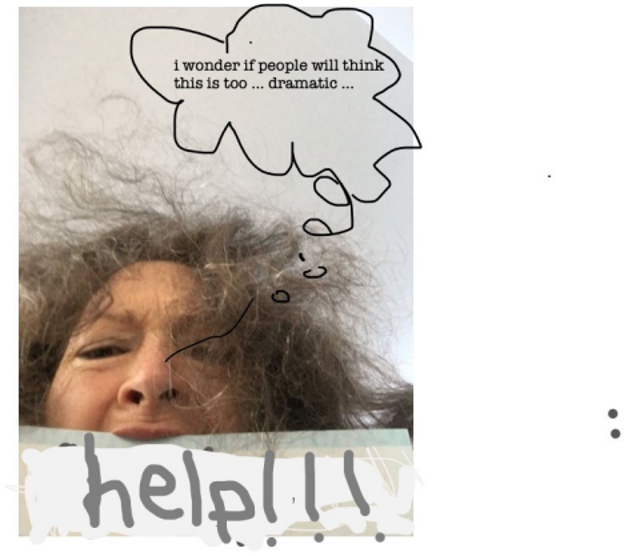
I first met Leeny through a writing community in Colorado several years ago. Despite much of her artistic life taking place in New York, as well as travelling throughout the world in various troupes and residencies, what ultimately brought us together was the intersection of creative exploration and contemplative intention that is cultivated at Naropa University in Boulder. In her own words, Leeny is “a postmodern ventriloquist, an interarts artist, a practitioner of I/Thou, I/It (Object Theatre), a Juifemme, perhaps a Baba Yaga, a daughter of Holocaust survivors, and is atypically-abled.”
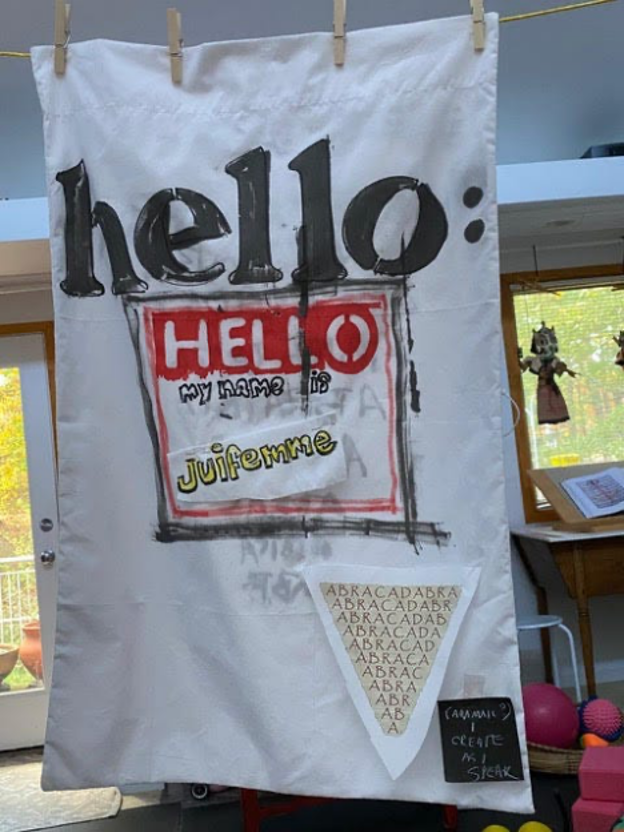
That bio alone demonstrates the complexities of identity, history, humor, and embodiment that weave throughout her practices. And also, it but partially scrapes against the surface of what she does/has done.
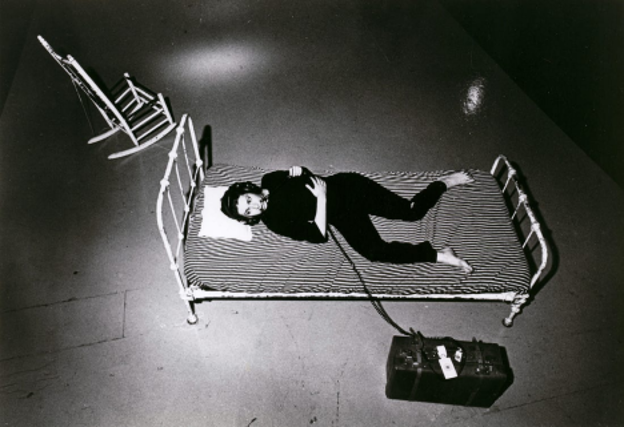
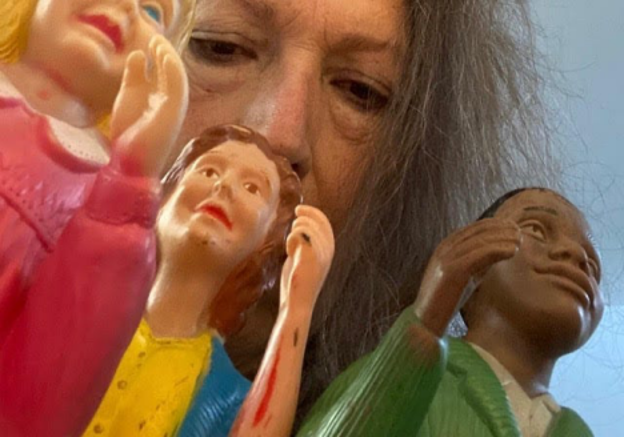
To look at Leeny’s cumulative body of work is to access an archive of what it looks like to devote one’s life to art. Never one to allow herself stagnation or complacency, Leeny’s time on this Earth has been filled to the brim with curiosity, questioning, and resistance through creative acts. Originally trained in theater, she was a member of Richard Schechner’s experimental The Performance Group and was founding faculty at NYU’s Experimental Theatre Wing. Her presence on the stage continued to evolve into solo theatrical shows, such as the piece The Survivor & the Translator about the resonances of the Holocaust imprinted on her through her parents’ experience. From there, she ventured more into the performance art and installation space, including her Paper Floor project, wherein a room is lined in large butcher paper and students/audience/participants are invited to leave marks upon it in exploration of their own embodiment, writing, and somatics. And then, Self & Things (I/Thou, I/It), a type of Object Theatre which explores using objects as stand-ins for the self and other while thinking, composing, and performing. Using items including fake food, figurines, bones, and miniatures, the resulting performances and images hum with the energy of existential observations and kinetic playfulness. And then there is her puppetry, particularly her collaborations with her ventriloquist dummies Lenny (of The Lenny and Leeny Show) and Jack (of The Jack and Sack Show).
Leeny has always been unafraid to push into her personal challenges as rich sites for artistic experimentation. As medical challenges arrived within her body, limiting or preventing the work she’d been doing, she pivoted directly into the energy of such experience. Her project Patient/Artist turns to her own medical diagnoses and procedures as source text, a literal interpretation of the adage “art is medicine.” In this project, the performance theater and the operating theater are the same space, the laboratory and the workshop akin.
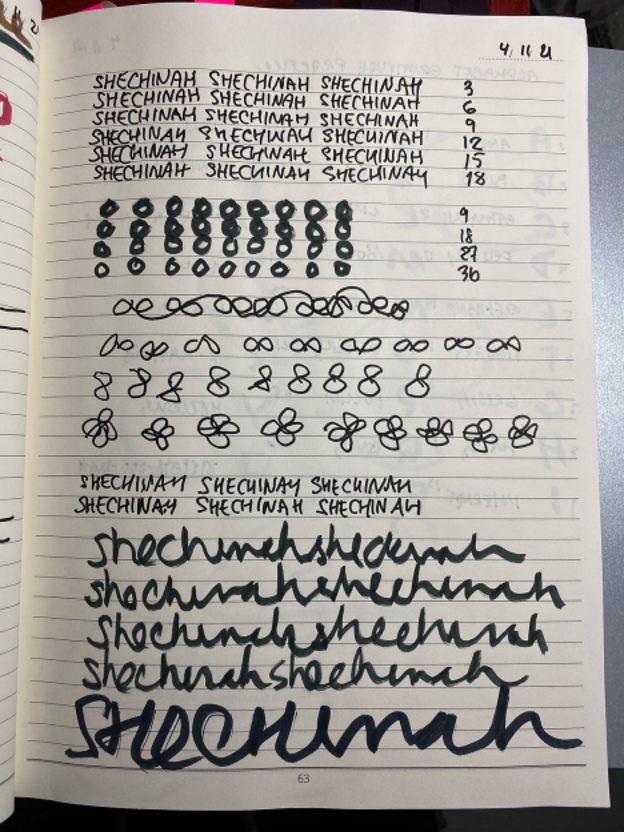
All the while, Leeny has been devout in her notebook practices, writing, and illustration as sites of research. Drawings—or what she calls visual prayers—are more active practice than static images. Sometimes they are an act of writing the same word over and over, counting and accumulating as one would with prayer beads. Or making infinity sign markings using her non-dominant hand and/or feet as a way to be in conversation with bilateral neuro-activation.
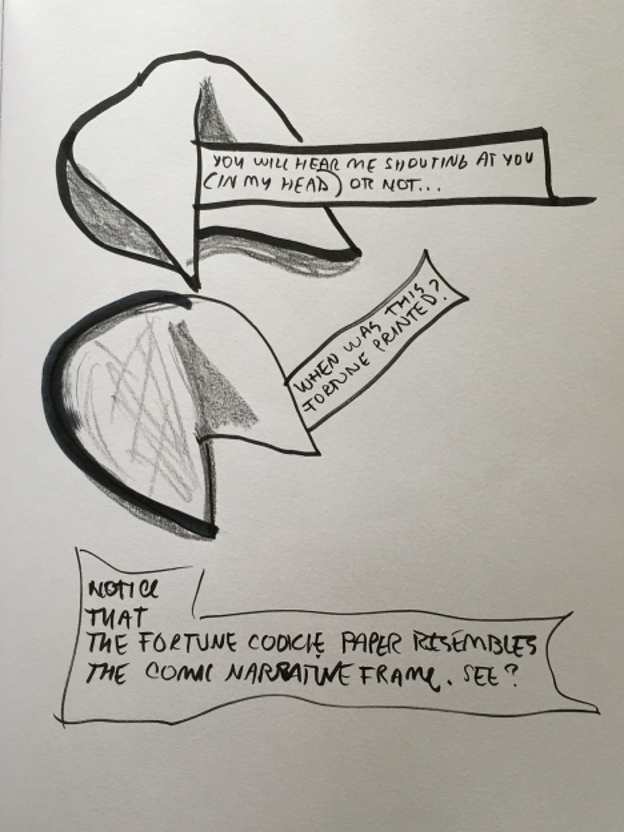
Her Fortune Cookie Oracle is a humorous and poignant deconstruction of our hunting and hoping for greater guidance beyond our own knowing, combining cute cookie doodles with philosophical questions and notations. And then there is her poetry, where she continues to filter the personal and the political into affecting verse that never ceases to pack a punch. (See her latest piece about resistance, mortality, and the anti-Nazi activist Sophie Scholl, recently published in East Window Journal of Written and Visual Arts.)
And all of these projects are only a fraction of her oeuvre. Throughout each piece runs a vein of heartbreaking self-awareness interwoven with dry and delightful humor. She is a living example of how to lean into the seeming contradictions (read: the realities) of being in these animated, funny, strange meat suits. And how to press beyond that, how to continue asking questions and trying something different. It is astounding, the amount of work she has produced (and continues to produce). Now moving ever further into the final act of her lifetime, she is left with the overwhelming question of what happens to one’s work once their life has culminated. It is a hard enough question for an artist who has a single primary medium. But for someone with as diverse a practice as Leeny, it can feel overwhelming, even impossible, to figure out a container for a so many separate but entangled threads.
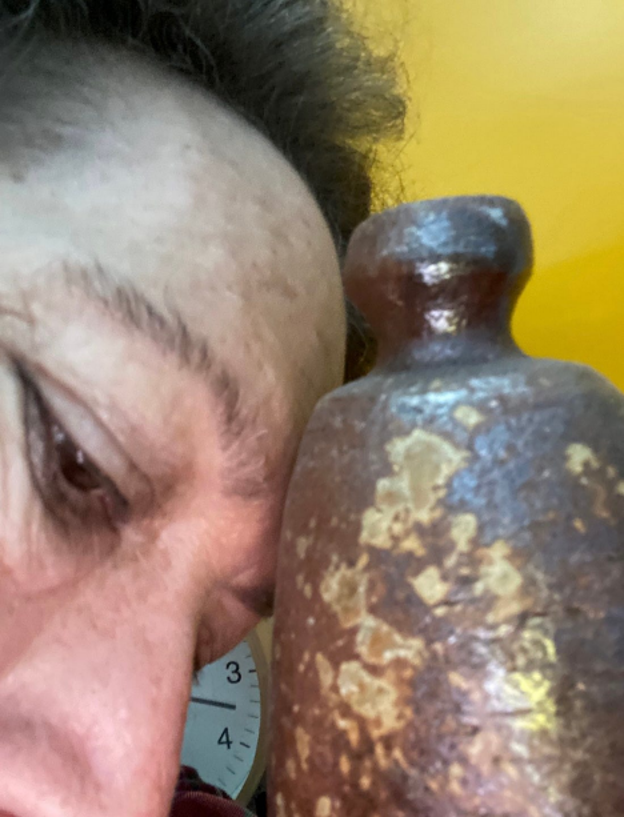
Leeny recently introduced me to the notion of zuihitsu-a Japanese writing form of loosely connected written fragments oriented around the author’s personal experience. A bricolage of sorts, the orienting anchor of zuihitsu is the author’s individual perception and perspective. As an artist feeling overwhelmed by the immensity (and sometimes perceived disarray) of her body of work, this format felt like permission, a landing place for all that she’s given her lifetime to culling forth without having to impose categorization to it retroactively. We have been working together finding ways to identify families of pieces that belong together, not so much in format or content but through energy, though practice, through the inherent aliveness of the work itself. Which means at this point, face-to-face with limited time and inevitable endings, her tactic has once again transmogrified into an autobiographical dramaturgy of sorts. A shapeshifter of creativity, even now she has found a new way of experimenting.
And this is all I can hope for in my life as an artist—to continue working, in some manner, is some way. To always find yet another path further, deeper. To continue locating a home and a language for the impulses I have no choice but to explore. To find ways to create and experiment, even as my body begins to tell me otherwise. The artist’s heart is a precious entity in this world. Leeny Sack’s certainly is, and I am so very glad to know it. To be able to share it with you.
With deep admiration for those who’ve come before, who continue the trek, Jade
BEDDED
by leeny sack
the revolution shall be from bed there is no other place now except the charnel ground from which to pray
to say
to sign
to shout
to think
unthink
perchance uh huh to dream to toss
yes turn
to burn
boots on the bed
‘the revolution will be from bed’
reads the guide for disabled activists ‘she called for it she called for it she called for the bed’
Inanna did
‘she called for the bed of queenship’ no king
just bed of nasty nails
for him for them
uh huh
‘the revolution will be from bed’ so reads the guide for disabled activists i’ve painted the pillowcases with slogans i’ve written prayers on the sheets top and bottom
they blow in my sleeping breath wake up
makeup
pray
a little prayer for you
and you and you and you and me
dear dear make me an instrument of your peace
make me a bed warrior